Journal / Field note
Why Do LLMs Hallucinate?
LLMs hallucinate because they generate text that sounds likely, not text looked up from a source of facts. When a fact is rare or missing, the model fills the gap with something plausible. Training and testing methods also tend to reward guessing over saying "I don't know." You can reduce hallucinations by giving the model sources, allowing it to admit doubt, and checking what matters.
What is an LLM hallucination?
A hallucination is a confident answer that is wrong or made up. Common ones include a citation for a paper that does not exist, a function that is not in the library, or a date that is off by years.
The model is not lying. It has no intent. It produces fluent text whether or not it has a solid fact underneath.
Why do LLMs make things up?
A language model is trained to predict what text comes next. For facts that show up everywhere, the plausible answer and the true answer are the same. For rare facts, there is nothing solid to lean on, so the model produces something that has the right shape.
A 2025 paper, Why Language Models Hallucinate by Kalai, Nachum, Vempala, and Zhang, makes this argument formally. It says rare, one-off facts are the hardest, and that some errors are statistically expected even if the training data were perfect.
Think of a name you half remember. A person might say "I'm not sure." A model is built to keep writing.
Why do LLMs hallucinate so much?
Part of the answer is that guessing pays.
The same paper argues that many benchmarks score a right answer as a win and give no credit for admitting uncertainty. Under that scoring, a model that guesses beats a model that says "I don't know." It is the multiple-choice exam problem: leaving a blank earns nothing, so you bubble something in.
Other things can make it worse:
- No source in front of the model. It answers from memory when it could have read a document.
- Leading questions. If your question assumes something false, the model may go along with it.
- Demands for a specific format. Asking for "five citations" can produce five, real or not.
Which questions get hallucinated answers most?
Watch out for anything that needs exact detail the model may have seen only once:
- Obscure people, companies, and events
- Precise numbers, dates, and quotes
- URLs and citations
- Niche or new APIs and libraries
- Anything that happened after the model's training data ends
General explanations of well-known ideas are safer. Specifics deserve a second look.
How do you reduce LLM hallucinations?
You can lower the rate. You cannot get it to zero. Try these:
- Give it the source. Paste the document, or use a tool that retrieves one. Models read better than they remember.
- Allow "I don't know." Say plainly that an uncertain answer is better than a guess.
- Ask for supporting quotes. Then check that the quotes are really in the source.
- Ask narrow questions. Small, specific questions leave less room to wander.
- Verify what matters. Click the links. Check the numbers. Run the code.
- Do a second pass. Ask the model to list which claims in its answer should be double-checked.
Search and retrieval help, but they do not make a model immune. A model can still misread a source or ignore it.
FAQ
Can LLM hallucinations be eliminated? Not today. They can be reduced with better sources, better prompts, and better checking.
Do newer models hallucinate less? Progress has been made, but the 2025 paper notes that hallucinations persist even in state-of-the-art systems. Treat any model as fallible.
Is a hallucination a bug? Not exactly. It is a side effect of how text generation works and how models are trained and scored.
Can I just ask the model if it hallucinated? It can help flag shaky claims, but a model checking itself is not reliable. Verify with an outside source.
If you want the shirt
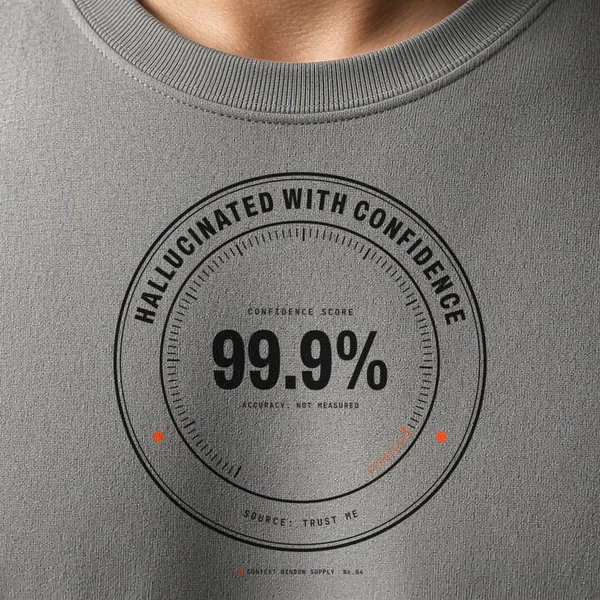
That was the explainer. If you also want to wear the general mood, the Hallucinated With Confidence Tee is $29 and printed on demand.
It is a joke for people who have watched a model invent a function with total conviction. It will not reduce your hallucination rate. Sadly.
Context Window Supply is independent and is not affiliated with any AI company.